A Symposium on the Cypriniformes Species Inventory, an International Project
2015 American Society of Ichthyologists and Herpetologists Conference, Reno, Nevada
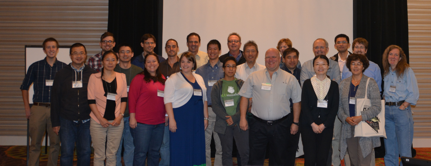
Left to right back rows: David Boyd, Randall Singer, Lei Yang, Zachary Randall, Ryan Thoni, Henry Bart, Milton Tan, Richard Mayden, Kenji Saitoh, Paula Mabee, Prachya Musikasinthorn, Lawrence Page, Chia-Hao Chang, Patrick Ciccotto, Alison Murray. Front Row: Yahui Zhao, Qiongying Tang, Carla Stout, Malorie Hayes, Ninon Martinez, Jon Armbruster, Qiu Ren, Susana Schönhuth. Not present in photo: Chavalit Vidthayanon and Olga Otero.
Click to see program detail
Welcome
This is the primary page opening to two very large research initiatives on Cypriniformes fishes: All Cypriniformes Species Inventory (ACSI-2) and Cypriniformes Tree of Life (CToL). You can learn more about both of these international-scale studies using the links available on our site.
"Cypriniformes Commons" has been developed to serve both the academic and lay communities and is an international portal to information on the diversity, evolution, systematics, and biology of this amazing and diverse group of fishes. As Cypriniformes fishes represent the most diverse group of freshwater fishes they serve as a fundamentally important group in the daily lives of people around most of the world, are incredibly important members of many lotic and lentic ecosystems and food webs, are aesthetically important in many homes and offices as popular aquarium species, and are some of the more important groups of fishes in many areas of research.
The Cypriniformes Commons encourages participation from the international community of aquarists and scientists working with these fishes to aid in accumulating and assimilating information through this site and providing links to other sources that may be of interest to this community. Cypriniformes Commons also serves as the launching site for two important international projects focusing on the diversity and evolution of Cypriniformes: 1) Cypriniformes Tree of Life - reconstructing the evolutionary history of these fishes and a new initiative 2) All Cypriniformes Species Inventory - focusing more on inventories and taxonomic descriptions of species.
Cypriniformes Commons continues to grow as we develop new applications, information, and ways to distribute knowledge on these fishes. Please visit some of our various links provided and our social network on Cypriniformes.
Please install Flash® and turn on Javascript.
If you encounter any security errors loading Monoslideshow, please update your security settings by adding the Monoslideshow folder to the trusted locations.